Why Decidim?
The context that has given birth to Decidim is defined by two interconnected phenomena, each of which displays two poles. On the one hand, the last decades have witnessed a crisis of representative democracy (weakening of the Welfare State, subordination to market forces, inability to deal with global problems such as climate change, etc.) as well as the essay with some alternatives, such as grassroots organizations, new parties and institutional forms. On the other, the rise of cognitive capitalism, a system where the exploitation of information, knowledge, affects, and social relations has become core to the generation of economic value, is opposed by the emergence of free software, knowledge and culture. Both phenomena are deeply intertwined, and Decidim is born right at their very intersection, responding to the challenges and opportunities that they open for democracy. In this section, we briefly analyze these two phenomena, with a special focus on the way they impact contemporary democracy.
The contemporary crisis of democracy and its alternatives
Success and decline of liberal, representative democracies. The basic structures of representative democracy have barely been updated in the last two centuries. The last three decades have seen both their success (with the multiplication of liberal democratic states all over the world) and their decline[1] (as diagnosed in a wide literature ranging from Pharr & Putnam, 1999 to Tormey, 2015). The decline has been expressed in various forms; we will mention two: practically, in the inability of contemporary democracies to deal with problems such as rising inequality (Piketty, 2014) or climate change (Klein, 2015); politically, in the decline of participation and trust in political parties and political representatives, as well as other political institutions (Mair, 2006; Castells, 2017).
Structural limits of representative democracy: the triple challenge of complexity.[2] The structure of modern democracies is based on representation (and, more specifically, electoral representation, Manin 1997, Van Reybrouck 2016), that is, on a series of mechanisms by which a few actors (political and administrative) are elected to manage public issues in the name of the whole of the citizenry, and are in principle accountable to it. Representation had its roots in medieval institutions, as a mechanism for nobles and knights to push their demands in exchange for consenting taxation (Pitkin, 1967). But it has proven its limits in coping with complexity and conflict: the complexity and conflictuality of society, of reality, and of organization.
-
In social terms, it had to face the growth of the franchise, incorporating an ever more diverse constituency, and, in the last decades of the XXth century, the rise in cultural diversity, consumerism and the ideology of consumer choice in Western democracies (Laclau & Mouffe, 1985; Sennett, 1977, 1998) that generated an ever-growing variety of desires and perspectives to be listened to and articulated in government action. Furthermore, representation has proven open to systemic practices of nepotism or corruption, usually by powerful economic interests (Buchanan & Tullock, 1962; Peltzmann, 1976). In this context, representative mechanisms have ended up imposing the will of the few over the complex and conflictual wills of the people in public policy.
-
The second key challenge of complexity had to do with the reality. As the technoscientific transformation of reality accelerated, the responsibility and complexity of the problems facing public policy (f.i.: climate change) has only increased; and yet many of the systems for detecting social problems and mobilizing social knowledge to address them have remained oligarchic. The attack Friedrich Hayek (1944, 1945) launched on socialist planning can be launched against representative democracy too: reality is too complex for a centralized decision-making system.
-
The third challenge of complexity fed back into the previous two: it is the challenge (or meta-challenge) of communication and organization. Mobilizing and organizing the will, the knowledge, and the collective action of society into public policy faced numerous socio-technological limits: the millions of members composing a given social group could not express their will nor contribute their knowledge and effort to address their matters of concern[3]. Still in the XXth century, the infrastructure required to bring an expression of will or knowledge of people distributed geographically or socioeconomically (f.i.: laborally) into a common problem or decision seemed out of reach. Even if they wanted, people could not gather in assemblies or other political processes: people were too many, lived far from each other, had their work schedules, and no free time at all.
Representative democracy, where the many elect a few every four years, became a raw and oversimplified articulation of the will and knowledge of the many, in terms of the management by the few. So raw and simplified that it couldn’t solve the problems of society and became one of them: the people’s will was not represented or properly constructed but captured, the real problems were not solved by public representatives, but externalized to the market to be solved, and the problems generated by the market too often remained unsolved.
Social limits of representative democracy: the challenge of economic powers and the rise of neoliberalism. The problems of representative democracy today are not of complexity only, though. They have as much to do with issues of social power. Many of the ailments of representative democracy in the last three decades can be rooted in three key shifts of power (DellaPorta, 2013: 23; Offe, 2011: 457): a shift of power from parties and parliaments to executive powers, reducing the meaning of parliamentary and party politics; from State to Market, with processes ranging from externalization and privatization of public services to the introduction of competition logics in public administration ( the process of “emptying out the State”, specially, the Welfare State, Rhodes, 1994), as well as the rise in power of global corporations; and from nation-states to international governmental organizations such as the EU, the IMF or the World Bank, frequently aligned with such corporations, emptying both States and democracies of much of their legitimacy and power (Laval & Dardot, 2017; Crouch, 2011; Sánchez Cuenca, 2014). Political parties have suffered particularly: from the mid XIXth to the mid XXth century, the mass party model was guided by clear programs and rooted in a thick social structure connected to grassroots spaces and organizations, unions, media, and so on. The catch all party model rising in the 80s, however, had pragmatic, variable programs and supported itself primarily in mass media (in particular, tv) and polls. A fragmentation of socioeconomic composition and the discourses around it, no more easily divisible into “capitalist and proletarians” (Laclau & Mouffe, 1985), as well as the rise of a mass-mediatized consumer society based on an exaggerated and depoliticising individualism (Sennett 1977, 1998) paved the way for such party transformations. The traditional mass party saw a steady decline of its grassroots in Western democracies until today. This emptying out of representative democracy was tied to the rise of neoliberalism[multiblock footnote omitted], and has brought a crisis of legitimacy and meaning of democracy itself, frequently identified with representation (Crouch, 2004; Streeck, 2016). The Great Regression of 2008 (Eichengreen & O’Rourke, 2009) and the austerity politics that followed it (Blyth, 2013) seemed to confirm this shift and its implications, with States first going into debt to save the financial sector and then applying (or being applied) austerity policies without or against citizen consultation, guaranteeing the sustenance of capital accumulation while losing more and more capacity for social provision (Jessop, 2015).
The alter-globalization challenge to the shift of power away from democracy. These processes haven’t gone unchallenged. The last two decades have been a period of democratic movements of resistance. At the turn of the century, the alter-globalization movement called for an alternative to the rising neoliberal globalization, an alternative globalization tied to a radicalization of democracy, social justice, human rights, as well as economical and ecological sustainability (Klein, 1999; Stiglitz, 2002; DellaPorta & Tarrow, 2005). This “movement of movements” had socio-technical networks as a key part of its organization. It generated a “cultural politics of networking” where networks operated not only as technologies, but also as models for the definition of social norms and political forms (Juris, 2008): features such as free association and information, non-hierarchical and flexible organizations, globally distributed but synchronized, locally rooted action, or autonomous networked media were among its key features.
The crisis of legitimacy of the neoliberal-democracy narrative. Beyond the work of these movements, it was the 2008 Great Regression what brought about a crisis of legitimacy of the neoliberal narrative. It opened a period of crisis of neoliberalism (Dumezil & Lévy, 2011), not so much in economics but, specially, in political and social terms (in economic terms the crisis lasted less, followed by a deepening of accumulation processes, Jessop, 2015): the discredit of narratives praising free trade, privatization, international economic institutions, and global markets, otherwise, the discredit of the ideological practice preeminent since the 80s, spread along with new social and political movements, from the progressive to the reactionary. This crisis of neoliberalism fed into the crisis of representation mentioned earlier, with a peak of distrust towards official institutions, from politicians and governments to banks. The result has been a crisis of the existing model of neoliberal representative democracy (Castells, 2012, 2017; DellaPorta, 2013; Gerbaudo, 2012, 2017).
The 2011 wave of networked movements of the squares. 2011 is a key year in political terms. Progressive social movements swept the world, from the Arab Springs in the North of Africa to Occupy Wall Street in North America: they challenged the political and economic status quo and the rising inequality, while reclaiming a more radical democracy (Postill, 2017; Gerbaudo, 2012; DellaPorta, 2013, Flesher Fominaya, 2014). The 15M movement was among the key referents of this wave of networked movements of the squares, which intensively used digital networks. In Spain, 15M was at the upshot of a cycle of contention that saw the emergence of new forms of collective organization (from the networked squares of 2011 to the direct action tactics of the Platform of People Affected by Mortgages Romanos, 2014), new political parties (from Podemos to Barcelona en Comú), and the victories in dozens of cities by citizen initiatives in the Spring of 2015 (Cádiz, Barcelona, Madrid, A Coruña, etc.) (Feenstra et. al, 2017; Calleja-López & Toret, 2019). The use of digital platforms were crucial in all of these undertakings, oriented to increase the depth of participation of anyone and everyone into the political field (Aragón et al., 2017; Calleja-López, 2017; Monterde, 2016; Toret et al., 2015). Digital networks seemed to provide spaces where the disaggregating forces of neoliberal society were partially and temporarily countered and redirected to nurture collective action both online and offline. The upward extractivism of global finance and corporations was answered with democratic, locally rooted and globally connected initiatives. In the case of Spain, the struggle around the city, from the squares of 2011 to city halls in 2015, has become ever more relevant in this trajectory, in the form of municipalism (Rubio-Pueyo, 2017; Junqué & Shea, 2018; Roth, Monterde & Calleja-López, 2019).
The rise of right-wing populism. But these achievements have showed limits and perils, too. At the international scale, the wave of movements tended to fizzle out. In countries such as Spain and Tunisia, the movements left new parties or constitutions, even though the general political and economic landscape remained gloomy (Castells, 2017); countries such as the US or Egypt (or Spain itself), has seen the advent of increasingly authoritarian governments. Moreover, right wing movements spread across Europe and North America (Castells, 2017). The final result has been defined as the end of the neoliberal era and the advent of a populist moment (Gerbaudo, 2017; Rodrik 2017), in which the basis of the status quo loses its compelling power and is challenged by actors invoking the common people, from left and right, with recent successes for the latter such as the rise of Donald Trump to the presidency of the US or the Brexit. The various negative effects of neoliberalism, particularly accelerated after the Great Regression, such as increasing inequality, the normalized connivance between economic and political power, the dismantling of welfare structures along with rising public debt, social and political disempowerment in the face of transnational corporate and financial powers, the eclipse of the public sphere resulting from phenomena such as a rising individualism or closed multiculturalism (Sennet 1977, 1998), have generated a suspicion towards the status quo in which right wing and nationalist positions are gaining ground. In many cases, such rise was facilitated by social networks such as Facebook and Twitter, used by corporations (such as Cambridge Analytica), or political actors (such as the Trump or the Brexit communication teams). We analyze the various edges of this phenomenon in the following chapter. Resuming, in the political plane, the last decades have witnessed the tension between processes showing the limits or undermining democracy and others trying either to stop such undermining, or even calling to radicalize democracy. Decidim is firmly rooted in this last trend.
The rise of the network society, cognitive capitalism and knowledge commons
First generation digital networks: informational networks. A similar opposition between conservative tendencies and progressive ones can be found on the moving field of the so-called digital economy. The 90s saw the rise of the Internet and the WWW to the status of phenomena of global proportions. The initial hopes for the cyberspace envisioned by figures such as John Perry Barlow (in this Declaration of Independence of Cyberspace) anticipated a time where many of the old social structures would be superseded by a new dawn of human creativity and freedom from old governments and social constraints (bodies, sexes, races, etc.). Since its origin, the construction of the internet resulted from the conflicting interests, visions, and practices of various actors (Abate, 1999; Rasmussen, 2007), specially, military and research actors. The idea of a distributed (and thereby resilient) information network was tied to the threat of possible high scale attacks to information centers by the Soviet Union (Baran, 1964), but even more so to practices and narratives of information and knowledge circulation and freedom among university researchers (Leiner et al., 1997). Already in the 1990s, a first generation of worldwide digital networks, informational networks, paradigmatically exemplified by the World Wide Web, allowed free the flow of information and users between websites.
Old and new communication powers: from mass communication to mass self-communication. This seemed to be the dawn of a “networked public sphere” (Benkler, 2006), where earlier mediators of social communication receded from view. The XXth century protagonism of capital-intensive media such as radio, newspapers or TV, with their olygocratic editorial teams, seemed to give way to an explosion of uncensored digital media such as websites and blogs. Social communication was said to be in its way to de-intermediation, its power to be more equally distributed (Rushkoff, 2002; S Republic of Letters in XVIIth and XVIIIth centuries), had been shaken in the XIXth and XXth centuries by technologies that afforded one-to-many circulation of informhirky, 2009). Early modern communication ecologies, based in one-to-one interactions, either face to face or via letters (which still generated complex systems such as theation such as newspapers, radio or TV: this was the model of broadcasting, which potentiated a centralization of social communication, mass communication, where a the majority of the public played a passive role. The Internet and social media afforded new versions of these earlier communication models, and combined it with a new model, that of many-to-many communication, in which many emissors were able to generate (and react to) messages reaching many others, without having to pass through any mediating center (Kellner, 1999). This was giving way to “mass self-communication” , a model in which mass communication is “self-directed in the elaboration and sending of the message, self-selected in the reception of the message, and self-defined in terms of the formation of the communication space” (Castells, 2009). This did not imply an equal redistribution of communication power in society but rather its re-structuration, with new actors, including networked social movements, having an opportunity to play a role in a media sphere earlier controlled by big corporations. The fourth power of mass media journalism gave way to a fifth power: digital networks (or perhaps to a complex, more decentralized form of the fourth, a “hybrid media system”, Chadwick, 2008).
The rise of informational and cognitive capitalism. The Internet and digital networks did not only affect the public sphere in a potentially democratizing tendency, they also greatly contributed to push globalization forward as a historical process, beginning with the acceleration of global finance (Castells, 1996). At the core of the economy behind neoliberal globalization were information and other immaterial assets, such as knowledge, affects, human relations, etc. The result was a new form of capitalism: informational and cognitive capitalism (Castells, 1996; Fumagalli, 2007; Moulier-Boutang, 2007; Vercellone, 2006). Differently from industrial capitalism, where the transformation of material resources into commodities was at the core of the process of capital accumulation, now it was information, knowledge, affects, and social relations what became key in the generation of economic value. Intellectual property is a key legal mechanism under this new paradigm, used to privately appropriate social knowledge and natural information, e.g.: strong copyrights on books and music, patents on technoscientific innovations, traditional medicines and techniques, or animal and plants DNA (Fumagalli, 2007). This in spite of the fact that information and knowledge are non-rival goods, with zero marginal cost, meaning that they can be reproduced and used without depletion. Furthermore, in most cases their value increases with use: the bigger the spread of trademark the higher its value, the more a song is listened to the higher its value. While digital networks provide the means to freely reproduce and re-distribute this kind of goods, artificial scarcity is generated via legal and technological mechanisms. This appropriation has not only the form of a “theft”, but is rather based on structures and processes (from education to entrepreneurship policies) that orient, transform and produce new personal and collective practices, desires, affects and relations sustaining the neoliberal system (Laval & Dardot, 2014).
From cognitive capitalism to platform & surveillance capitalism. In time, the digital element in these processes has only gained prominence. The so called web 1.0 (O’Reilly, 2005) exhibited various limits to users’ interactions with both digital contents and other users. Differently, web 2.0 was all about interaction: the web as a platform. This exponentially increased the quantity and quality of information that could be extracted. By the late 2000s the emancipatory hopes tied to social networks were heavily in dispute (Morozov, 2011), and by the late 2010s the situation seems to be rather the opposite of the anticipated. From Amazon to Tinder, technological platforms are a way for a few corporations to extract data (going from activity, to opinions, to metadata), while leaving users with a little a say on what is gathered, how it is used or how the resulting benefits are distributed; this institutes a regime of “data extractivism” (as suggested by Evgeny Morozov). These corporations have access to more details of the lives of millions of people than any State or corporation to date. Combined with the development of new techniques of big data analysis and the always increasing rate of computing power, the infrastructural conditions were there for a socioeconomic mutation. Corporations such as Google or Facebook were heralding a specific form of informational and cognitive capitalism, which has been variously qualified as “platform”, “data” or “surveillance” capitalism. These three names speak of three connected elements: digital infrastructures, data, and social control. Digital platforms have become the basic means of production and management of a valuable resource (data) out of its source, human activities (Srnicek, 2017). Data, considered as the new “oil” (The Economist, 2017), “infrastructure” (Kawalek & Bayat, 2017; Prospect, 2017), “labor” (Arrieta et al., 2017), etc. is processed using data science methods and business intelligence (from modern statistics to Artificial Intelligence). Then, it is used in various ways in social processes of data-driven politics, science and economics (Lohr, 2015). This process of extraction, processing, and use is radically oligarchic. Corporations such as Alphabet (which includes Google), Microsoft, Amazon or Facebook have earned a monopolistic position[4]. A few actors have become the owners of both platforms and data and can thereby surveil social life in order to experiment with it: surveilling thereby appears as a first step to what we may define as “surwilling”, or willing and shaping the will of others from above; otherwise, platform corporations move from unveiling social life to orienting (or “willing”) it from above. If surveillance intrudes into privacy, into the negative freedom of people (to use Isaiah Berlin’s), into their freedom-from, surwilling shapes their positive freedom, their freedom-for. Platforms crucially influence the information people get about others and about the world, be it from friends, social actors, mass media, advertising corporations or beyond. The result is the emergence of new forms of knowing and influencing the actions of millions of people, a new techno-political power in the hands of States (such as NSA programs), corporations, or political actors (such as the Trump or the Brexit communication teams). This surveillance (Zuboff, 2015) and surwilling capitalism brings ever closer to a Big Brotherhood dystopia.
Towards technopolitical heteronomy? From mass self-communication to mass capture. Social networks such as Facebook or Twitter have grown to user bases in the billions in only a decade. This has turned them into new intermediaries of social communication, if not of social life as such. Mass self-communication has risen hand in hand with mass capture, the capture of masses of data, human actions and interactions. These platforms feed from, and feed on, some dynamics already diagnosed by Guy Débord (1967) around the society of the spectacle, heralding a society of hypervisibility and exhibition tied to capitalism. Exhibition and self-exhibition (from the intimate everyday life to political opinions and actions, passed through a variety of fiction filters), are stimulated and situated at the center of the functioning of these platforms (Crogan & Kinsley, 2012; Goodwin et al., 2016), which are in turn at the center of an economy of attention. Furthermore, in social networks, surveillance and control is not only top-down but also bottom-bottom. There are two axes of surveillance, vertical and horizontal. While the first tends to be unidirectional, the second is frequently (though not always, as platform privacy settings are variable) horizontal and multidirectional: users can and do surveil each other, with playful or predatory (Albrechtslund, 2008; Tokunaga, 2011) purposes. The monopolistic concentration of power around social network corporations becomes daunting: Facebook, for instance, also owns Instagram and Whatsapp. Key rules of social relations are not produced in and decided by processes, actors or conflicts spread in space and time, but rather are increasingly decided and designed by a reduced number of people and specific interests (geostrategic, economic, etcetera). The power of social networks moves from selling advertisement (a concrete type of content) to a deeper shaping of social attention and affects (Grizzioti, 2016), and thereby, behavior. The social anomie resulting from several decades of neoliberalism had given way to a landscape in which the autonomy resulting from new forms of multitudinous self-organization in networked social movements was underlied and exposed to new forms of corporate influence via technologies, that is to say, technopolitical heteronomy.
How datacracy is dissolving democracy. Democracy became exposed to datacracy, namely, to the strategic use of big data and digital platforms to gain and exercise political and cultural power (Cancellato, 2017; Gambetta, 2018). The rise of Barack Obama in 2008 and Donald Trump in 2016 to United States presidency are examples of how social networks and big data operations have a growing impact on electoral processes, affecting the networked public sphere. Trump invested 94 million dollars in expert consultants and Facebook’s paid advertising services (The Guardian, 2017). More importantly, the campaign included numerous examples of political automation: the use of chatbots, posting bots, false profiles and the automated inflation of metrics and followers (Bessi & Ferrara, 2016). These were frequently tied to the diffusion of fake news: biased, incomplete or spurious media stories with exaggerated and emotional adjectivation (Graves, 2018). This fed back with the activity in platforms such as 4chan, Omegle, Reddit and Tumblr, where Trump’s followers formed an irregular community, self-appointed as Alt-Right (Nagle, 2017a; 2017b), which showed clear manifestations of sexism, xenophobia, islamophobia, anti-feminism, intolerance and white supremacy, openly or in the form of satirical jokes and memes (Mendoza-Denton, 2018, Van-Zuylen Wood et al, 2018; Pollard, 2018). He may also has been supported by Russian espionage and communication experts, who received large financial incentives, showing the geopolitical character of these technopolitical struggles (The Guardian, 2018a). Finally, there was the hiring of London consulting company Cambridge Analytica, which extracted personal data from 87 million Facebook profiles between 2014 and 2016 to analyze their political preferences (De Llano, 2018), using a Facebook application disguised as a “personality test” (Cadwalladr, 2018; The Guardian, 2018b). This is not exceptional, though. Cambridge Analytica intervened in the last presidential campaigns of Argentina, Mexico, Brazil, Sri Lanka, Malaysia, China, Australia and South Africa, as well as the referendum that caused the separation of Britain from the European Union, known as Brexit (The Guardian, 2018b). These cases have drawn public attention to issues such as the vulnerability of online personal data, the power of corporations and States that can access these databases (either legally or illegally) and use these platforms for influencing and shaping public discourse and action (Mottram, 2018; Tufekci, 2018). In words of Facebook’s founder and president, Mark Zuckerberg, the platform has no affinity with any political party, and any client can access its services (Price, 2018). However, Facebook algorithms keep working as “black boxes”. Zuckerberg’s company has never shared details of its technical operation or data processing software or policies besides the content of Facebook’s terms of use, which still remain general, abstract, and non-negotiable. This opacity becomes ever more problematic as the role of platform algorithms, political automation and Artificial Intelligence (including machine and deep learning) systems grow (Trevathan, 2006; Manovich, 2013; Zysman & Kenney, 2015, 2016). Datacracy will pervade more aspects of people’s lives to the extent that the increasing pervasiveness of digital platforms grows and follows the current corporate and technocratic logics.
Free software, knowledge, culture, and internet. However, in continuous struggle and contact with these dynamics there has also been a proliferation of actors, movements, practices and projects oriented by principles such as democracy, freedom, social justice, or commonality. For instance, as an alternative to commercial social networks, also in the second half of the 2000s, there emerged alternative social networks, from Diaspora (with more than one million users) to n-1, a platform widely used during the 15M movement, together with a self-managed network of blogs (wordpress), voice-call rooms (mumble) and collaborative real-time writing pads (etherpad). They followed in the steps of a tradition dating back, at least, to the 1980s and 1990s: the WWW and free software such as the GNU/Linux operating system, have provided free digital services (free as in “freedom” and not only as in “free beer”, as Richard Stallman put it[5]) to millions of people over world. Furthermore, the GNU license was a legal tool to produce and reproduce such free digital infrastructures. The Creative Commons license expanded its possibilities to cultural works. First, free software licenses and, later (as the principles and practices of free software spread to other fields, Kelty, 2008) creative commons licenses helped to outline an alternative paradigm of collective appropriation of informational and cognitive wealth. Projects such as Wikipedia brought the free software culture into knowledge. This neatly fitted with the discourse of scientific knowledge (Merton, 1942), traditionally self-proclaimed universalism, communalism, and disinterestedness, specially up to the 1980s and landmarks such as the Bay-Dohle Act, that put science into a path of closure, privatization, and corporate interestedness. By putting the classic Encyclopedia Britannica and Microsoft’s Encarta out of business Wikipedia became an example of and alternative “open knowledge” regime, from its production to its appropriation. Softer forms of this regime, such as “open access”, have gained solid ground in time. Under this alternative paradigm, platforms for digital collaboration became key in the collective production of information and knowledge out of the proprietary logics of informational and cognitive capitalism. The broad category of “digital commons” has served to encompass a variety free software, knowledge and culture products. More broadly, the term FLOK (Free/Libre Open Knowledge) includes also non-digital forms of knowledge that generate common practices and democratic communities out of the proprietary form: from education to hardware, from engineering to culture, from biology to software (Villa-Viñas & Barandiaran 2015). More recently, struggles around Net Neutrality (have brought to the front the centrality of the control of concrete aspects of a common such as the Internet (in this case, the discrimination a types of data traffic on the network by service providers and governments) for the flourishing of other basic rights such as freedom of speech or equality in the network society[6].
Hacker culture, digital communities and knowledge commons. Free/Libre and Open Knowledge does not stand simply as a commodity or a good that is accessible by means of legal and technical devices. It is followed and often preceded by certain forms of social relation, modes of production and the collaborative culture that is necessary to produce and sustain it. The hacker culture, often associated with an ethics of fun, openness and sharing (Himanen, 2003), is even so with concrete practices (Kelty, 2008) and forms of politics (Barandiaran 2003; Maxigas, 2012); crucially, it involves the attitude to transform the way in which artifacts (in its broader sense: from institutions to modems) are given to us in order to open them up to new possibilities: a practical believe on the capacity (both individual and collective) to challenge existing limits and to collaboratively explore how to break, re-assemble and build upon what is available. In doing so communities are created around technical challenges, common infrastructures, collective resources and struggles. In turn, these communities are faced with a myriad of governing problems and these are solved by a combination of recursive tools and democratic/collaborative procedures: from the mechanisms to solve disputes in Wikipedia, to the voting procedures of the Debian community, from Forks (the duplication of the content and resources of a project to create a new one, something that is made possible by the non-proprietary form of knowledge and technologies involved) to version control systems in software development. Added to the unlimited reproductive capacity of digital goods, all this provides the sphere of Free/Libre Open Knowledge with a productive power and collective management capacity that results on a knowledge commons that often parallels that of profit-driven corporations and has been the object of extensive study (Hess & Ostrom, 2007; Benkler, 2006).
Decidim in context. As we have shown, democracies in the network society face the double challenge of the crisis of representative democracy and the rise of platform capitalism. The first phenomenon is tied to neoliberalism (and its periodic crises) as well as to the emergence of progressive and reactionary networked politics. The second phenomenon underlies new social conditions as well as those very forms of networked politics, while it is opposed by commons-oriented forms of production. The following image can help to understand the role of Decidim in this context.
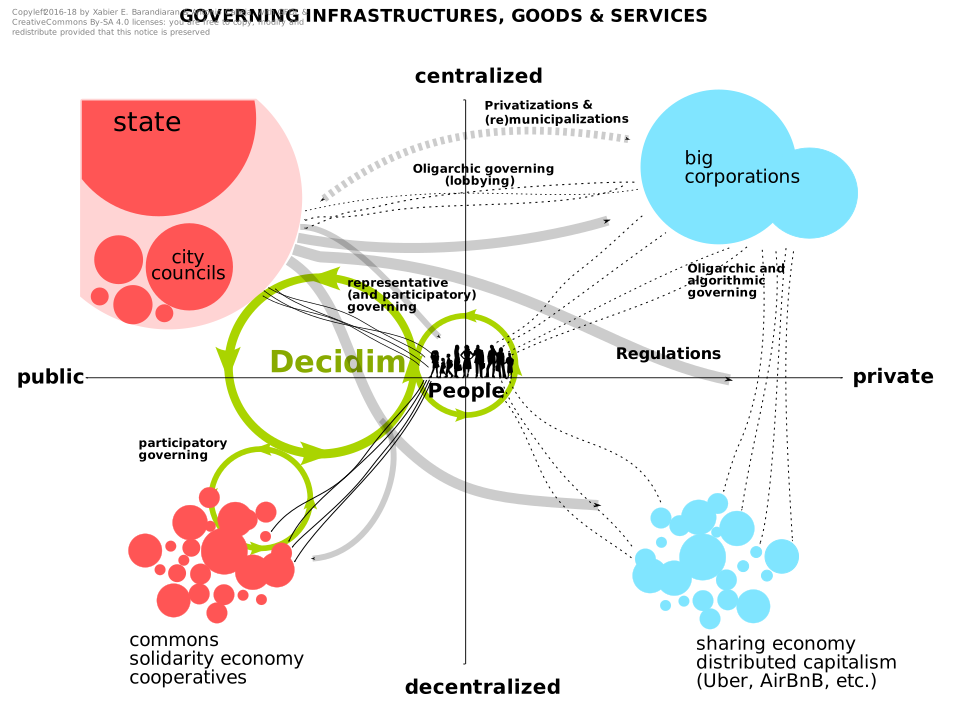
Under platform capitalism, corporations extract social data in huge quantities and turn it into wealth and power over people and institutions (this is what, in the image below, we label “algorithmic governance”), challenging democracy as we know it. New forms of distributed platform capitalism (airbnb, uber, deliveroo, etc.) herald forms of capilar exploitation of social wealth. However, non-corporate, collaborative forms of digital production exist, and they make possible to find alternatives. Decidim is one such alternative. It is conceived as a commons’ digital infrastructure for participatory democracy that is publicly supported and democratically designed, using itself for such purpose. The value of Decidim stands out in a context in which democratic collective intelligence faces the challenge of corporate artificial intelligence and datacracy, where the democratic impulse of networked social movements, from alter-globalization to 15M, faces reactions by market, State and right wing forces, and where public and commons’ institutions require democratic innovative infrastructures to overtake market-driven innovation in solving the complex social challenges of our times. Whereas a dominant trend pushes the governing of infrastructures and services to the top-right of the picture, towards increasing privatization and centralization in the hands of big corporations, the socio-technical potential exists to shift this trend towards the bottom-left corner: towards decentralized and public-common’s ecosystems of services, infrastructures and goods. Decidim contributes to this transition by boosting democratic participation into the governing of public bodies, social organization, the cooperative economy as well as the joint circulation among the three. So far, public emphasis has been put into regulating consumer markets, corporate governance and economy as a means to slow down privatizing trends and its negative consequences; meanwhile, corporate interests keep exerting their lobbying influence into the public and state institutions. Instead, Decidim contributes to the strengthening of innovative forms of commons-oriented economy and participatory democracy. The next section deals with “how” this strengthening operates, explaining how Decidim explores the potential of participation at various scales.